
Introduction
Building Information Modeling (BIM) is transforming how teams coordinate documentation across disciplines. Rather than individual isolated drawing sets, BIM enables a shared digital workspace where designers, engineers, fabricators, and contractors collaborate without losing clarity.
This blog explores how BIM connects documentation workflows and improves project outcomes from concept through execution.
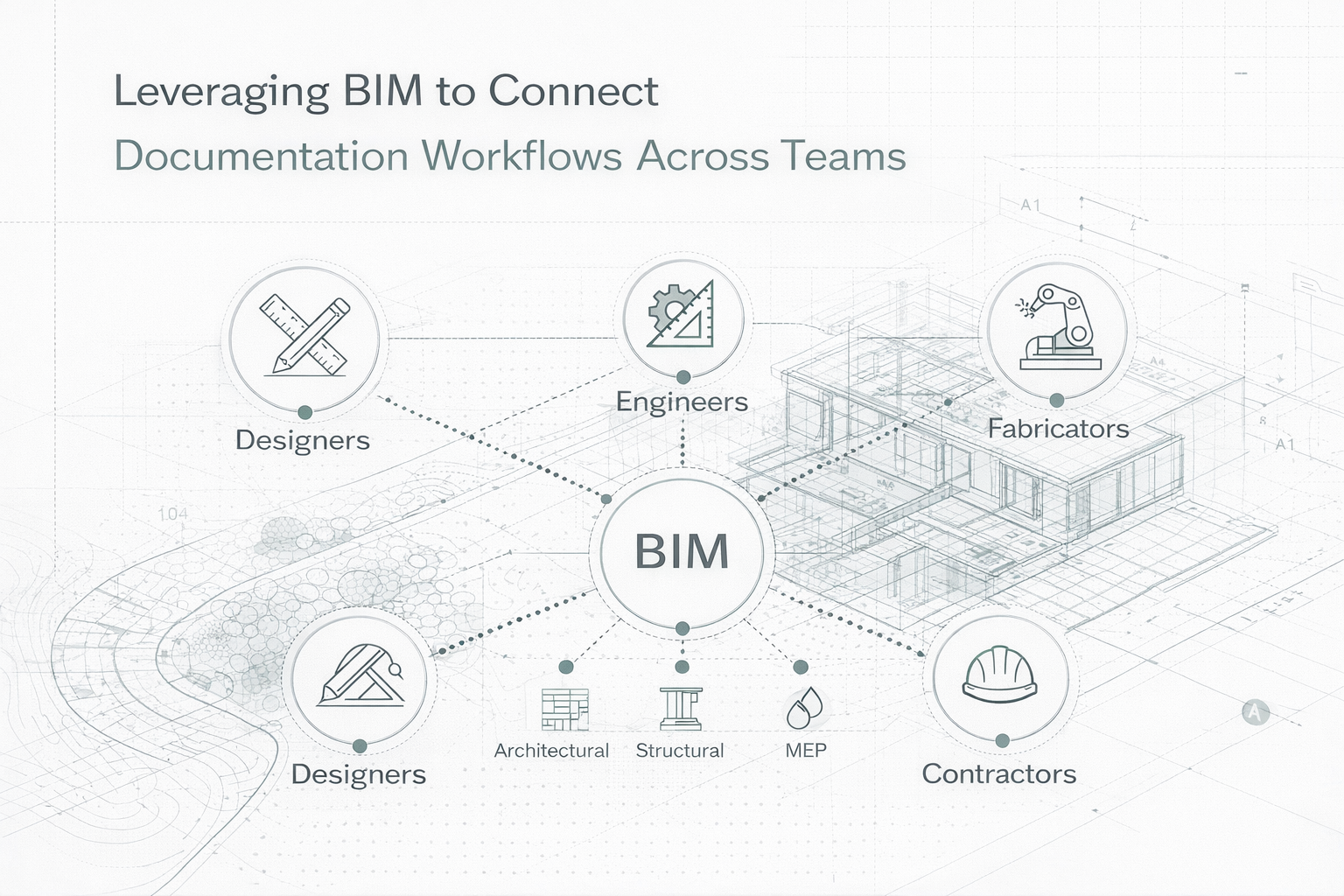
What Makes BIM Unique for Documentation
At its core, BIM is a central, intelligent model that:
- Integrates multiple disciplines
- Standardizes shared data
- Supports real-time coordination
- Reduces redundant work
Unlike traditional CAD, BIM is not a set of disconnected files — it’s a living shared environment that teams access, update, and refine together.
Unified Documentation Through BIM
When teams adopt BIM:
- Architectural intent is linked to engineering logic
- Clash detection avoids on-site surprises
- Quantities update automatically
- Changes propagate across documentation
This unified approach reduces contradictions between sheets and ensures that drawings reflect real turf conditions.
Benefits for Multidisciplinary Teams
Designers & Architects
- Maintain design excellence
- Validate spatial logic
- Visualize systems early
Engineers & MEP Coordinators
- Access accurate structural and spatial context
- Reduce clashes with architectural and electrical systems
Fabricators & Manufacturers
- Extract precise dimensions and details
- Generate shop drawings from coordinated models
Contractors & Site Teams
- Plan installation sequence
- Use coordinated drawings to avoid rework
- Synchronize trades with confidence
How BIM Improves Documentation Workflows
1. Real-Time Collaboration
Team members share and update the model live, reducing version conflicts.
2. Automated Drawing Generation
BIM allows repeated extraction of drawings as the model evolves, reducing manual drafting effort.
3. Clash Detection and Coordination
Conflicts between disciplines are identified early — before fabrication or site installation.
The Future of BIM Documentation
Forward-thinking teams are:
- Using cloud-based BIM for global collaboration
- Integrating BIM with project management tools
- Feeding BIM data into facilities management
Documentation is no longer static — it evolves with the project.
Conclusion
BIM is not just a modeling tool — it’s a documentation engine that connects teams, reduces risk, and accelerates delivery. When teams embrace BIM as their source of shared truth, project execution becomes smoother and more reliable.
Expert BIM Coordination & Documentation Services
Our team specializes in coordinated BIM workflows and documentation that connect architects, engineers, fabricators, and contractors seamlessly.
Learn more about how BIM reduces construction risk across disciplines. Explore BIM vs CAD workflows to understand when to use each tool.
Ready to improve your BIM and documentation workflows? Check out our BIM modeling and coordination services.